Dunlin on Arran
Reports
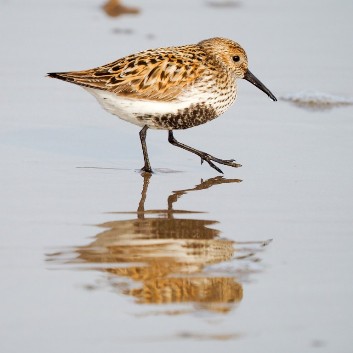
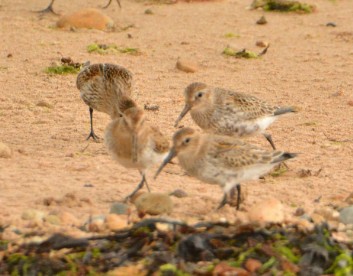
On Sunday 11 October 2026, Terry Southall and the local ringing group were on Cleats Shore when a group of Dunlin flew along the coast. The count was fifty-one. Terry felt that this one of the largest counts of this species that he had seen on Arran.
On a dreich morning in October, I checked all the Dunlin Arran records on BirdTrack over the last almost twenty years. There are five hundred and twenty-six Dunlin records on Arran on BirdTrack. Only fourteen are of twenty or more birds and of those fourteen only four are of thirty or more birds: 38 Drumadoon Point on 28 July 2013; 30 Porta Buidhe on 12 August 2016; 68 on Cleats Shore on 11 October 2017; and 40 at Clauchlands on 22 October 2023. Two of these records were also in October and two of these records were also provided by the ringing group. The record this October of fifty-one was indeed a large group of Dunlin.
On Arran Dunlin is a regular passage migrant with records from most months of the year but mainly in the spring and autumn. While there is no obvious trend in the number of reports received each year, last year, 2025, only sixteen records were received. That was quite a drop from forty-nine records the previous year.
Dunlin previously bred on Arran. According to Gray’s account in the “Birds of Arran” (Bryce 1872) Dunlin were “plentiful breeding on all the hills of moderate elevation in the district”. In the early nineteen eighties the bird was described as a rare breeder but in recent years there have been no breeding records.
These changes in Arran are matched by declines in many areas south of the Great Glen so that now in Scotland, the breeding birds are concentrated in the Flow Country of Sutherland and Caithness and in the peatlands of the Northern Isles, Outer Hebrides and the Grampian Mountains. Open areas of grass and moss, near pools and wet flushes in upland and moorland are favoured breeding places. There was a serious decline in numbers in the Uists following the introduction of hedgehogs there in the nineteen eighties.
Internationally, there are nine sub species of Dunlin breeding in a continuous band right round the Arctic. All the species migrate south to winter at more southerly latitudes mainly along the coasts as far south as the equator.
It is on this passage in both spring and autumn that you are most likely to see this wader on Arran’s shores. Its fat shape and slightly down-curved bill are worth studying, so you'll find it easier to pick out less familiar shore birds. Most Dunlin in spring and autumn show signs of either the black belly which is part of the smart breeding plumage or black spots on the flanks which are typical of juvenile plumage. Only in winter plumage do they have completely clean flanks and bellies and then you have to rely on shapes and sizes to identify them. In flight, the Dunlin is one of a dozen small waders which show a pale wing bar and white sides to the tail.