April 2026
Bird Sightings
April is the month when spring migration gets underway, with arrivals and departures of birds, all seeking their best breeding territories. While the weather at the start of the month was unsettled, the second half was generally dry and calm. Observer activity seemed to be encouragingly high with one hundred and twenty-eight species recorded. This is the highest monthly total that I have ever received. The previous highest monthly total was one hundred and twenty-two in May 2019.
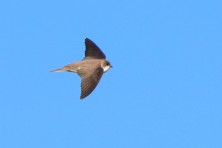
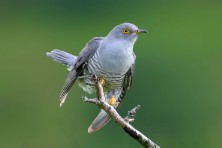
As reported at the end of March, the first Chiffchaff, Sand Martin, Sandwich Tern, Wheatear and White Wagtail had arrived. Here are April “firsts” with the 2025 arrival date in brackets for comparison: Manx Shearwater 1st(7 March), Willow Warbler 7th(31 March), Swallow 7th(20 March), House Martin 8th(1 April), Common Sandpiper 13th(11 April), Cuckoo 16th(7 April), Garden Warbler 19th(18 April), Grasshopper Warbler 23rd(21 April), Whitethroat 23rd(21 April), Whinchat 24th(24 April) and Tree Pipit 26th(24 April).but these were just the pioneers the bulk will arrive throughout April and May.
In April some of our wintering birds were still around, including two hundred Greylag Geese with four White-front Geese in the Shiskine Valley on 1st, eight Teal in South Carlo on 3rd, one Purple Sandpiper at Drumadoon Point on 6th, five Wigeon in Machrie Bay on 8th and a Barnacle Goose in Brodick Bay on 26th. In the Shiskine Valley the migratory Greylag Geese left by mid-April while some of naturalised Greylag Geese population that hang about Lamlash Bay were on nests.
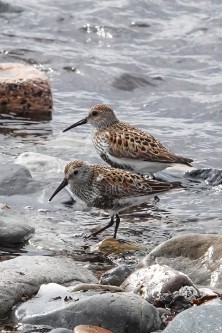
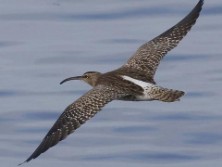
April is an ideal time for watching migration. These are a few examples: two skeins of one hundred and fifty Pink-footed Geese over Kilbride Hill on 2nd, two Greenshank in Sannox Bay on 4th, 30 Whooper Swan also in Sannox Bay on 6th, a male Ring Ouzel in North Newton also on 6th, fifty-six Turnstone in Machrie Bay on 7th, one Common Scoter also in Machrie Bay on 8th, twenty-six Redshank in Kildonan also on 8th, eleven Sandwich Tern on Sliddery Shore on 19th, five Red-throated Diver in Cosyden also on 19th, six Twite on Sliddery Shore on 23rd, four Dunlin in Blackwaterfoot on 26th, fourteen Linnet in Pirnmill on 26th, forty Whimbrel on Sliddery Shore on 27th and thirty-seven Great Northern Diver in Blackwaterfoot on 30th. Migration was also in evidence from the widespread reports received of Goldfinch, Siskin and Lesser Redpoll moving through people's gardens throughout the month. Tens of thousands of birds seem to be moving through the island at this time of year.
In April there were one hundred and twenty-eight species recorded on Arran. One of these, Little Egret , again over-wintered on Arran. I wonder if this species will breed on Arran for the first time this year. The solitary wandering Magpie that was reported at the end of March was last reported on 3 April. In addition there were three species reported in April that had not been reported on Arran for some time. Two Jay on Whiting Bay Golf Course on 4th, last report 2021, one Little Gull off Pirnmill on 9th, last report 2013 and three Common Tern in Brodick Bay on 21st, last report also in 2013. Both Little Gull and Common Tern will feature in future Bird Notes. Here is a further small selection from the April list: two Puffin in Brodick Bay on 1st, a Nuthatch on Corrie Golf Course on 5th, (only one record in 2025), a Red Kite on Ballymichael Glen on 21st, an adult White-tailed Eagle over Bennan Head also on 21st, three Fulmar by Drumadoon on 28th, seventy Gannet in a feeding frenzy off Blackwaterfoot on 28th and two reports of Osprey one in the Shiskine Valley on 6th and one over Mossend Pond on 15th.
From a birding point of view, May should be an equally interesting month with the bulk of our summer visitors arriving including more species like Lesser Whitethroat, Spotted Flycatcher, Arctic Tern and hopefully, even Corncrake and Nightjar. Please continue to keep me posted on all summer visitors in your area. Your ongoing support is much appreciated.
Finally, spring is a great time to be birding, as most birds are getting on with the business of breeding. The business of breeding involves attracting a mate by song, courtship display and ritual, defining a territory, nest building, and generally establishing relationships. Please take a moment to report any signs of breeding birds to me. Already there have been reports of Blue Tit nest building, Skylark singing, Blackbird carrying food, Woodcock roding, Sandwich Tern courting while migrating, Hen Harrier sky-dancing, Lapwing displaying in a small number of areas and House Sparrow feeding young at garden feeders and on 30th.
Please remember that under the Nature Conservation (Scotland) Act 2004 it is an offence to intentionally or recklessly damage or destroy the nest of any wild bird while it is being built or used. Take particular care on our shores and beaches and please keep your dogs on a lead at this time. They are a danger to all our ground nesting birds. At all times follow the Arran Wildlife Code.