Lesser Whitethroat on Arran
Reports
On 1st July 2026, members of Arran Bird Ringing Group heard a male Lesser Whitethroat singing and then trapped and ringed a female Lesser Whitethroat with a brood patch. A few days later on 4th July, in a different location, a juvenile was trapped and ringed. All birds were by the coast at the south of Arran. The last Arran record of this species was on 4th June 2022 near Catacol.
The Lesser Whitethroat (Curruca curruca) is a common and widespread Old World Warbler which breeds in temperate Europe, except the southwest, and the range extends as far east as Siberia and Mongolia. This small passerine bird is strongly migratory, wintering in Africa just south of the Sahara, Arabia and India.
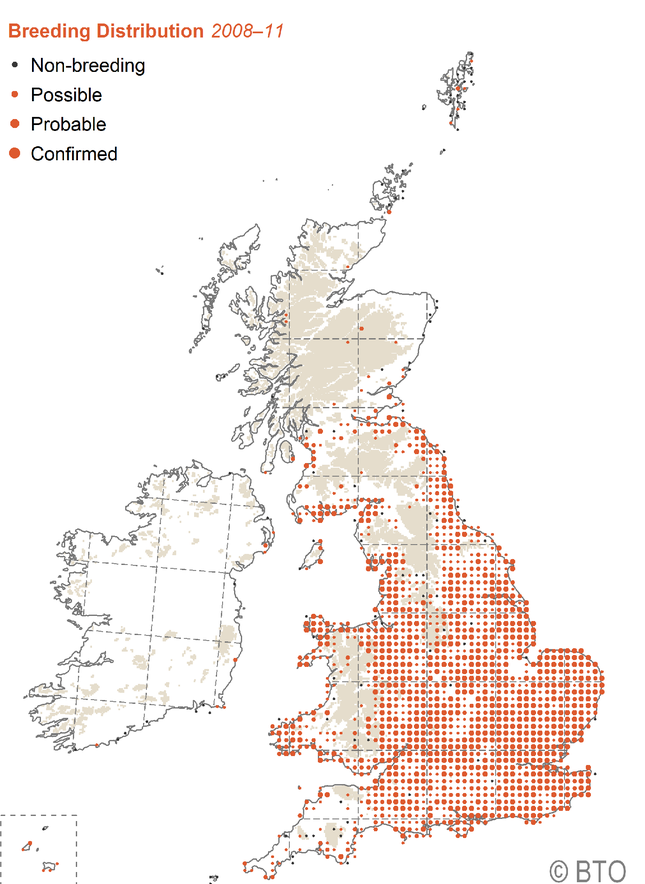
Scotland is at the edge of the species European range and is prone to fluctuations in the numbers returning in spring. Breeding was not confirmed in Scotland in the 1968-72 breeding atlas but there was an expansion into Scotland from the mid-seventies. The Map shows breeding distribution in 2008-11. It is a scarce summer visitor breeding locally in parts of southern Scotland.
On Arran in 1985 there was a male heard singing in late May in Kildonan. This was the first Arran record for thirty years. There were two further records in the 1980s. In the 1990s there were records in four years. In the 2000s there were records in eight years. In the 2010s again there were records in eight years. In the 2020s there were two previous records before the record this month. Nearly all these records were of single singing males.
In Scotland Lesser Whitethroat prefers areas of dense ungrazed hawthorn and blackthorn often coastal scrub with an open canopy that allows sunlight to penetrate to ground level encouraging a dense undercover of gorse, bramble and dog rose. This combination is vital as most nests are in dense undergrowth about a metre off the ground. This preference is also reflected on Arran where most records have been along the south of Arran stretching from Kildonan, Auchenhew, through Cleat towards Corriecravie. Others areas where it has been reported have included Kingscross and Catacol.
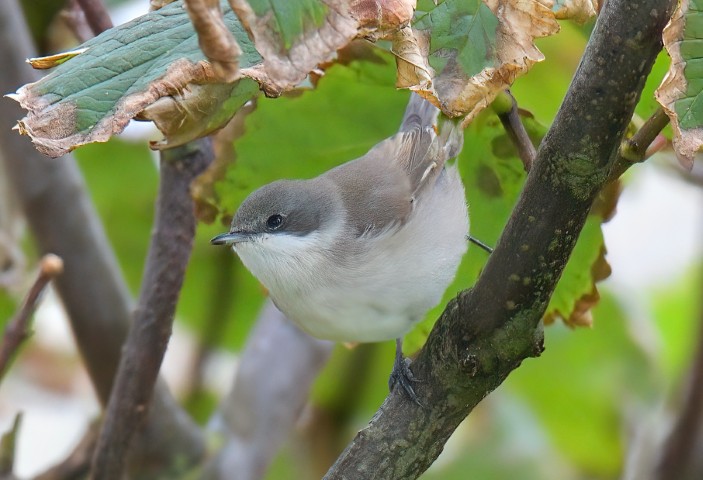
Unlike many slyviid warblers, the sexes of Lesser Whitethroat are almost identical. This is a small species with a grey back, whitish underparts, a grey head with a darker "bandit mask" through the eyes and a white throat. It is slightly smaller than the common whitethroat and lacks the chestnut wings and uniform head-face colour of that species. The Lesser Whitethroat's song is a fast and rattling sequence of tet or che calls, quite different from the common whitethroat's scolding song.
In the Arran Bird Report of 1991, Tristan ap Rheiallt, the bird recorder then, had an article on Lesser Whitethroat. In his introduction he wrote “Lesser Whitethroat is an elusive, though apparently increasing species in Scotland”. (Full article available here) That is still the case today.